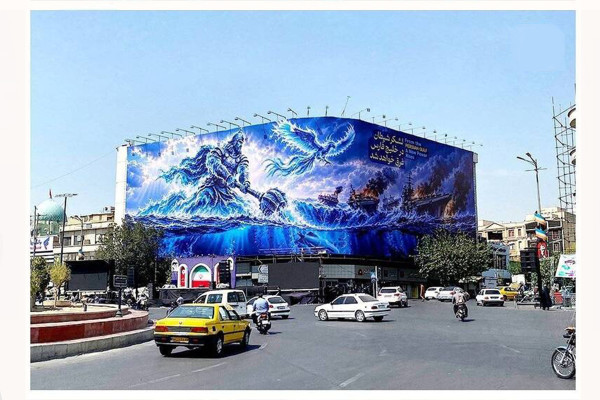
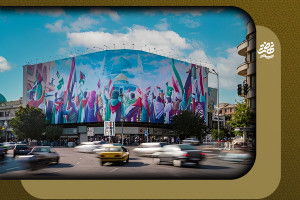
Bearing the slogan “The Army of Satan Will Sink in the Persian Gulf”
New mural unveiled at Tehran’s Enghelab Square
Religious Values Must Be Woven into Everyday Life
People do not always have to walk into a formal hall and sit through an educational program to hear about lifestyle and values. Sometimes, a cultural initiative can take its message into city squares—places where families gather, enjoy entertainment and encounter religious and social themes in a more informal setting.
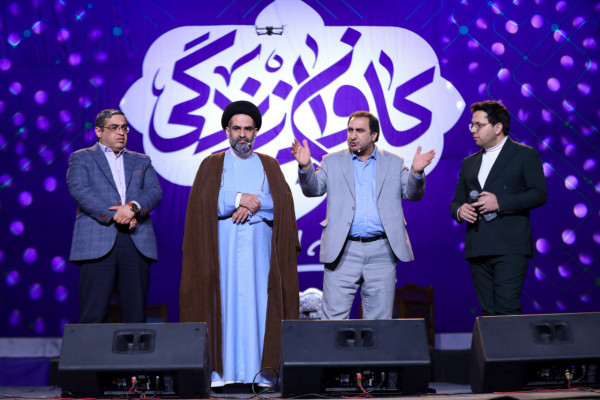
The National “Life” Caravan was launched with this approach by the Tebyan Institute, an Iranian cultural and media organization active in producing and distributing religious, cultural and educational content. The program aims to promote what is referred to in Iran as an “Iranian-Islamic lifestyle,” bringing together Qur’anic and religious teachings, entertainment, expert discussions, devotional chanting, music and activities tailored to the culture and atmosphere of each city.
The caravan began its activities in December 2025. After holding several events in indoor venues, it expanded into public spaces and city squares. According to its organizers, the aim is to present the Qur’an and the teachings of the Ahl al-Bayt—the family of the Prophet Muhammad, who hold a central place in Shia Islam—in a less formal setting through entertainment, dialogue and direct interaction with the public.
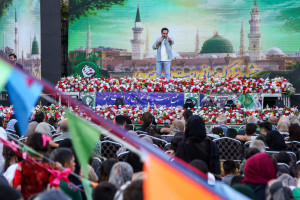
The “Life” Caravan has so far held 10 events across nine provinces. Its most recent event took place at Revolution Square in Zanjan, where, according to the caravan’s director, between 8,000 and 9,000 people attended. Isfahan has hosted the program twice, while Bushehr, Kerman, North Khorasan and Semnan have also been among its destinations.
The program initially targeted beneficiaries of the Imam Khomeini Relief Foundation, a government-backed organization that provides support to low-income and vulnerable families in Iran. Over time, however, its audience expanded, transforming the caravan from a program designed for a specific group into a broader public initiative staged in urban spaces.
From an Initial Concern to the “Life” Caravan
Masoud Khatami, director of the “Life” Caravan, says the idea for the program was initially proposed by the Relief Foundation. The organization wanted to hold a cultural program for its beneficiaries, but there was no suitable group available to implement it. The Tebyan Institute was subsequently approached and agreed to take on the project.
Khatami describes the program’s content as follows: “The Life Caravan is an Iranian-Islamic cultural package in which Qur’anic verses and the teachings of the Ahl al-Bayt are presented through joy and laughter. The structure of the program is built around the same idea, from an energetic host to teachers and experts, each of whom engages with the audience in their own field of expertise.”
According to Khatami, the first events were held indoors, with programs for Relief Foundation beneficiaries in the mornings and performances for the general public in the evenings. Gradually, however, the program’s capacity to engage larger crowds led it into city squares and other public gathering spaces.
From the Hall to the City Square
Moving the program outdoors did not mean changing its core content. Lifestyle remains at the heart of the program, while its Qur’anic and religious material has been retained. What has changed is the addition of elements suited to the atmosphere of a large public gathering.
“The content we started with is still there—the discussion of lifestyle through Qur’anic verses and the teachings of the Ahl al-Bayt,” Khatami says. “Alongside that, given the nature of public spaces, we have added revolutionary music videos, Allahu Akbar chants and other elements suited to large gatherings.”
The shift has also opened the door for community and religious groups to invite the caravan to their cities. Isfahan is one example: local hey’ats—community-based groups that organize religious ceremonies and observances—directly invited the caravan to hold a program there.
Every City Has Its Own Story
One of the program’s defining features is its use of local cultural elements. As a result, the events do not necessarily follow a single fixed format from one city to another.
Khatami says local organizers in Zanjan asked for the entire Surah Al-Fath, or “The Victory,” to be recited as part of the program. During the war between Iran, the United States and Israel, which began in early 2026, reciting the surah became, among some Iranians, a symbol of hope for victory over the enemy. The association also reflects the surah’s title—“Victory”—and the theme of its opening verses. According to Khatami, people in Zanjan had been reciting the surah every night, and the caravan organizers decided to incorporate the local practice into their program.
The Zanjan event also featured entertainment, devotional chanting, music videos and expert sessions. According to Khatami, one of the Qur’anic segments was presented in a lively format, while religious chanters, religious scholars and psychologists took part in the program. A singer would typically perform at the end.
When Religious Lifestyle Becomes Part of Everyday Conversation
What distinguishes the “Life” Caravan from a conventional lecture or educational program is its attempt to bring religious concepts closer to everyday life. In this model, religious content is presented alongside entertainment, music and conversation, allowing audiences to encounter it in an informal public setting.
The move from dedicated indoor venues to city squares has also broadened the program’s audience. What began as an initiative designed for a specific group now reaches families and members of the wider public in different cities.
For the organizers, the shift is about more than changing the location of the events. It is an effort to move the conversation about an Iranian-Islamic lifestyle beyond the confines of formal programming and into the community itself—into spaces where families and different segments of society naturally come together.
2026-09-07



T
T